
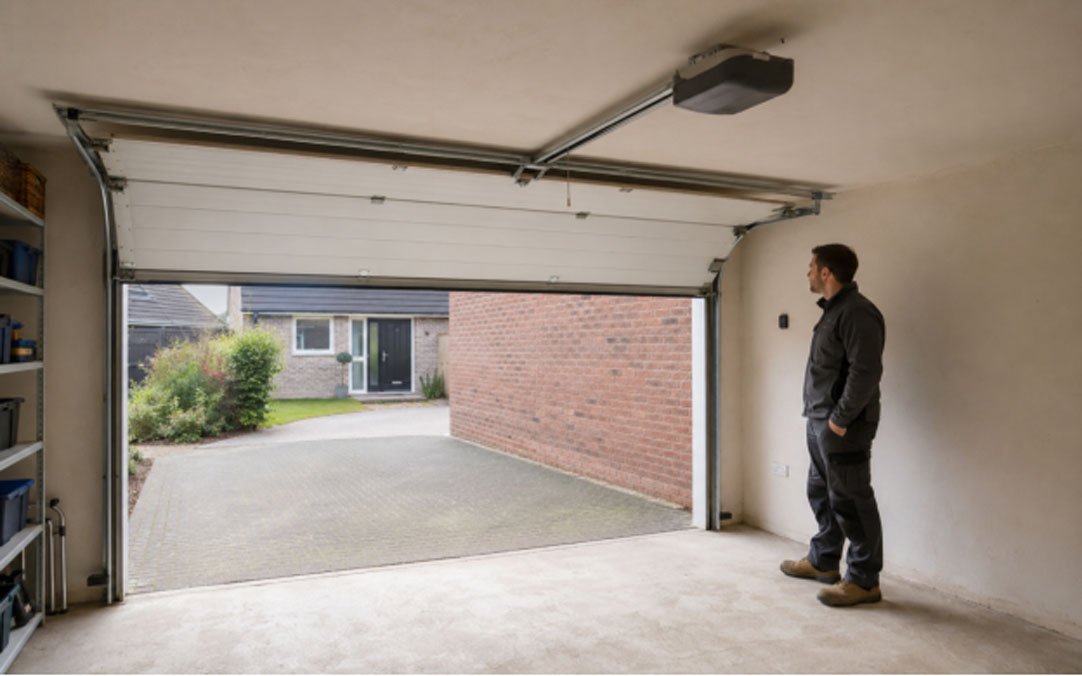
Automating an existing garage door can make daily access easier, particularly when the garage is used frequently or the driveway is exposed to bad weather. Yet a powered operator is not a cure for a door that is worn, badly balanced or unsuitable for conversion.
A careful survey should consider the door, opening, structure, controls and safety arrangements as one system. The following checks help a homeowner understand whether a retrofit is sensible and what to discuss with a competent installer before any equipment is chosen.
Start with the door’s mechanical condition
Observe how the door behaves during normal manual use. Warning signs include unusual weight, jerky or uneven travel, rubbing, grinding, visible damage and a door that will not stay where expected. These symptoms do not identify the fault, but they show that the mechanism needs professional assessment before a motor is added.
Springs, cables and counterbalance components can store considerable energy, so adjustment or repair is not a homeowner task. An installer should confirm that the door is in sound condition, correctly balanced and compatible with the proposed operator. Automation must not be used to force a stiff or damaged door through its movement.
Confirm that the opening can accept an operator
Measure clearances and obstructions
The visible opening is only one part of the measurement. Sectional and some up-and-over arrangements may need ceiling space for tracks and an operator rail, while roller systems require room for the curtain housing. Beams, lights, pipes, shelving and roof supports can all affect the available route.
Inspect the supporting structure
The frame and surrounding structure must be suitable for the door and its fixings. The survey should also account for the floor, threshold, weather seals and the location of a safe electrical supply. A useful quotation explains any preparation work rather than treating the operator as an isolated accessory.
Choose controls around the daily routine
Think about who enters, how often and from which direction. A remote control may suit vehicle access, while a keypad or other access option may be more practical for family members arriving on foot. Available features vary by product, and connected controls should be assessed for account management, updates and what happens if a phone or transmitter is lost.
When comparing automatic garage doors, ask which controls are included, whether partial opening is supported and how additional users are added or removed. The answer should relate to the selected door and operator, not a generic list of smart features.
Plan for a power cut or failed control
A garage with no separate pedestrian entrance needs particular attention because the normal internal release may be inaccessible from outside. Ask the installer to specify the correct arrangement for the property and to demonstrate it at handover. Emergency release methods are model-dependent and should only be used as described in the manufacturer’s instructions.
Also confirm what the door does when power returns. Some operators need a reference movement or other reset, while others behave differently. Every regular user should know the safe procedure rather than trying unfamiliar controls during an outage.
Make safety part of the specification
A powered door introduces movement that must be controlled and tested correctly. Ask how the complete installation manages contact with an obstacle, which protective devices are fitted and how their operation will be demonstrated. The appropriate solution depends on the door, operator, controls and how the opening can be approached.
Children should not play with controls or near a moving door, and people should not pass through until the opening is safely available. If stopping, reversal or travel becomes unreliable, stop using the powered function and arrange inspection. Never bypass a safety device to keep the door working.
Agree the handover and maintenance plan
Before completion, request the operating instructions, control details and an explanation of the safety features and release arrangement. Record which visual checks the owner may perform and which inspections or servicing the manufacturer requires. There is no universal interval that suits every product and usage pattern.
Retrofitting can be a practical upgrade when the existing door is sound, compatible and worth retaining. If it is damaged, difficult to move or poorly suited to the opening, compare the full retrofit cost with a correctly specified replacement. The best decision is the one that produces a coherent, safe system rather than merely adding a motor.