
Paying Zakat online sounds simple. You open a website, enter your details, click a button, and you are done.
But many Muslims make costly mistakes before they even reach that button. They donate to the wrong organization, miscalculate their Zakat amount, overlook eligible asset categories, or choose platforms that lack proper Sharia oversight. These are not minor errors. Zakat is one of the five pillars of Islam. Getting it right matters both spiritually and practically.
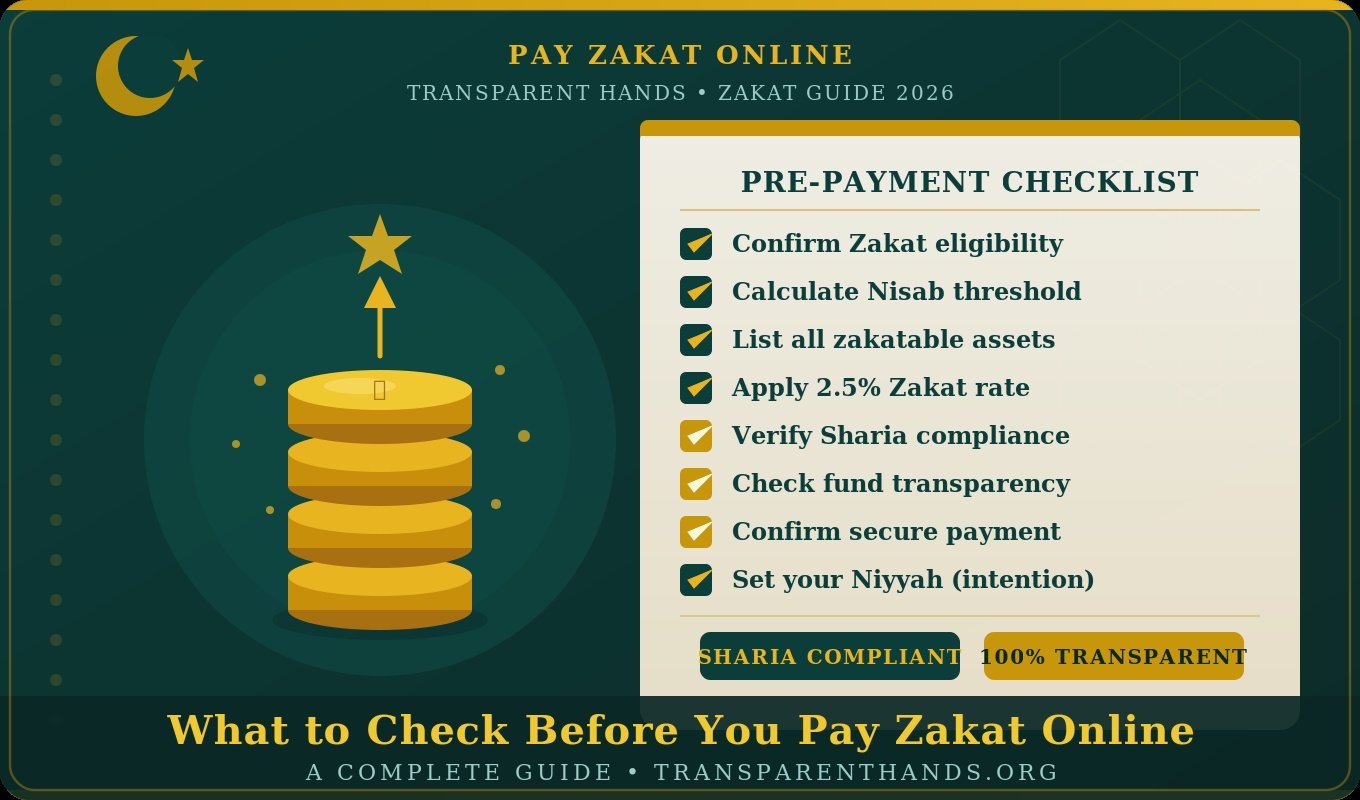
This guide walks you through every check you need to complete before you pay Zakat online — so your obligation is fulfilled correctly, your money reaches the right people, and your donation counts exactly as it should.
Why More Muslims Are Paying Zakat Online
Muslims across Pakistan, the United States, the United Kingdom, Canada, Germany, and Australia now choose to pay Zakat online rather than through direct cash donations. The reasons are straightforward.
Online platforms offer verified recipient lists, transparent fund tracking, Sharia-compliant calculation tools, and secure payment gateways that accept credit cards, debit cards, bank transfers, and PayPal. You can fulfill a religious duty from your home in minutes, with a clear record of where every rupee or dollar went.
But this convenience comes with responsibility. Not every platform that collects Zakat handles it correctly. Before you donate, you need to do a few important checks.
Check 1: Confirm Whether You Are Eligible to Pay Zakat
Before anything else, you need to know whether Zakat is actually obligatory for you this year.
Zakat becomes mandatory when four conditions are met:
You are Muslim, adult, and sane. Zakat is not required from children. Their parents or guardians are not obligated to pay Zakat on their behalf unless the child’s own wealth meets the Nisab.
Your wealth meets the Nisab threshold. The Nisab is the minimum amount of wealth a Muslim must possess before Zakat applies. It is calculated based on the current value of either 612.36 grams of pure silver or 87.48 grams of gold. Because silver and gold prices change, the Nisab in monetary terms also changes. As a reference point, the silver-based Nisab currently approximates USD 487 to USD 1,797 depending on the current silver price. Always check the up-to-date Nisab value before you calculate.
You have owned this wealth for one full lunar year. This period is called the Hawl. If your wealth only recently crossed the Nisab threshold, you must wait until one complete Islamic lunar year passes before Zakat is due.
Your wealth is in excess of your immediate needs and debts. If you owe loans or have outstanding liabilities, you subtract those from your total assets before calculating.
If all four conditions apply to you, Zakat is obligatory. If you are unsure, consult an Islamic scholar or use a reliable Zakat calculator before you proceed.
Check 2: Calculate Your Zakat Amount Accurately
Many donors underestimate or overestimate their Zakat because they do not account for all zakatable asset categories. Before you pay Zakat online, compile a full picture of your qualifying wealth.
Assets that are subject to Zakat:
- Gold in any form — jewelry, coins, bars — whether you use it or not
- Silver in any form
- Cash held in bank accounts, savings accounts, or at home
- Business inventory and trade goods
- Stocks, shares, and investment portfolios (the zakatable portion depends on the nature of the investment)
- Outstanding receivables — money owed to you that you expect to receive
- Agricultural produce (different rules apply here based on the school of jurisprudence)
- Livestock above a minimum threshold (for farmers and those who own animals for trade)
- Rental income and profits from business
Assets that are not subject to Zakat:
- Your primary home
- The car you personally use for transport
- Personal clothing, furniture, and household items
- A property you live in (as opposed to one you rent out)
- Cash that falls below the Nisab amount
Once you identify your zakatable assets, add up their total monetary value. Subtract any legitimate liabilities — outstanding loans, debts you owe, or business payables. Apply the standard rate of 2.5% to the remaining amount. That figure is your Zakat obligation.
Transparent Hands provides a free online Zakat calculator on their website that follows standard Islamic guidelines. It covers all major asset categories and subtracts liabilities automatically, giving you a precise figure rather than an estimate.
Check 3: Verify That the Organization Is Sharia-Compliant
This is the most important check on this list, and it is one many donors skip entirely.
Not every organization that accepts Zakat donations distributes them in accordance with Sharia. For Zakat to be valid, the funds must reach recipients who fall within the eight categories defined in Surah At-Tawbah (9:60):
- The poor (Al-Fuqara)
- The needy (Al-Masakin)
- Zakat administrators
- Those whose hearts are to be reconciled
- People in bondage (to free them)
- Those in debt (Al-Gharimin)
- Those striving in the way of Allah (Fi Sabilillah)
- Travelers in need (Ibn As-Sabil)
If an organization distributes Zakat funds outside these categories — for example, to general infrastructure projects, non-Zakat-eligible causes, or to recipients who do not genuinely qualify — your Zakat may not be valid.
Before you pay Zakat online to any platform, ask one clear question: does this organization operate under the guidance of a qualified Islamic scholar or Sharia advisor?
Transparent Hands is Sharia-compliant and operates under the oversight of a qualified Sharia advisor. When you give Zakat through Transparent Hands, you donate to verified patients who are poor and unable to afford medical treatment — a clear fit within the Al-Fuqara and Al-Masakin categories. The platform also labels individual patient campaigns as “Zakat Eligible” so you know exactly which cases qualify for your Zakat donation.
Check 4: Confirm Full Financial Transparency
A significant concern for Muslims who pay Zakat online is the question of accountability. Where does the money actually go after the transaction is complete?
A trustworthy platform provides several forms of documentation and reporting:
Patient or recipient verification: Every beneficiary should be screened and verified before their case goes live. You should be able to see their details, diagnosis, and financial need.
Fund utilization reports: After a patient receives treatment, the organization should publish their medical bills, hospital records, and success story on the platform. This confirms that your Zakat reached a real person and funded real care.
Audit reports: Reputable organizations publish annual audit reports that independent accountants verify. This gives donors confidence that the accounts are accurate and the funds are properly managed.
Donor tracking: Ideally, you should be able to track the progress of the specific campaign you funded — from the initial donation to the completed treatment.
Transparent Hands takes financial transparency seriously. The organization uploads all patient medical documents and hospital bills on its website after treatment. Donors receive regular updates on patient progress, and the platform maintains publicly accessible audit reports. This level of visibility is not common in charitable giving, and it removes the uncertainty that causes many donors to hesitate when they pay Zakat online.
Check 5: Confirm the Platform Has Secure Payment Processing
When you pay Zakat online, you share financial information. You need to be certain the platform handles your data securely.
Look for these indicators before completing a transaction:
HTTPS encryption: The website URL should begin with “https://” — the padlock icon in your browser confirms the connection is encrypted.
Recognized payment gateways: Reputable platforms process donations through established gateways that comply with financial security standards. Transparent Hands accepts payments via credit card, debit card, bank transfer, and PayPal — all processed through 100% secure payment modes.
No unnecessary data requests: A legitimate Zakat platform will not ask for excessive personal information beyond what a standard financial transaction requires. Be cautious of any platform that asks for data it does not need.
Registered charity status: Transparent Hands is registered as a non-profit organization in both Pakistan and the United States (under IRS 501(c)(3)), and in the United Kingdom. This registration makes them accountable to government oversight and financial reporting requirements in multiple jurisdictions.
If a platform lacks these features, do not proceed. There are too many verified organizations available for you to take risks with unaccountable ones.
Check 6: Confirm You Are Donating with a Clear Intention (Niyyah)
This is a spiritual check rather than a procedural one — but it is essential.
Zakat is an act of worship. The Prophet Muhammad (SAW) said: “Actions are judged by intentions.” (Sahih Bukhari) Before you pay Zakat online, make a clear intention in your heart that this payment is your obligatory Zakat, given solely to seek the pleasure of Allah (SWT).
This matters because Zakat and Sadaqah are different. If you intend your payment as Sadaqah (voluntary charity) rather than Zakat, it does not fulfill your Zakat obligation. Many online platforms collect both Zakat and Sadaqah, so choose the correct category when you make your donation.
Also confirm that you are not counting the same donation twice across years or applying Zakat money toward a debt you owe. These errors seem minor but they affect the validity of your obligation.
Check 7: Understand What Happens After You Pay
Before you finalize your payment, understand the process that follows.
A good Zakat platform tells you:
- How soon the funds will be allocated to a patient or recipient
- What happens if a campaign is fully funded before your donation is processed
- Whether unused funds go to a general Zakat-eligible pool or are returned to you
- How and when you will receive confirmation and updates
Transparent Hands allocates Zakat donations to verified Zakat-eligible patient campaigns. Once a patient’s campaign is fully funded, treatment is scheduled at a verified panel hospital. Donors then receive post-treatment updates, including medical reports and recovery details. If you have a specific patient in mind, you can select their campaign directly and fund it. If you prefer to give to the general fund, the platform allocates your donation to the next eligible patient in the queue.
The Spiritual Weight of Getting It Right
Allah (SWT) says in the Quran:
“Take from their wealth a charity by which you purify them and cause them increase.” (Surah At-Tawbah, 9:103)
Zakat purifies your wealth. It removes the spiritual weight of accumulation and returns to the community what rightfully belongs to those in need. When you pay Zakat online correctly — with accurate calculation, verified recipients, Sharia-compliant handling, and sincere intention — you fulfill one of the most fundamental duties in Islam.
The Prophet Muhammad (SAW) also said: “The wealth of a Muslim is not complete until he pays Zakat.” (Sahih Bukhari) Paying Zakat is not optional for those who qualify. And paying it correctly is not optional either.
The checks in this guide are not administrative formalities. They are the steps that separate a Zakat payment that truly counts from one that falls short.
Why Transparent Hands Is a Trusted Choice to Pay Zakat Online
Transparent Hands was established in 2014 as Pakistan’s leading online healthcare crowdfunding platform. Since then, it has helped over 250,000 patients receive free medical and surgical treatment.
When you pay Zakat online through Transparent Hands, you benefit from:
Verified Zakat-eligible recipients: Patients are individually screened for financial need. Only those who qualify under Sharia criteria are labeled Zakat-eligible on the platform.
Sharia oversight: A qualified Sharia advisor oversees the collection and distribution of Zakat funds to ensure complete compliance.
Full transparency: Medical documents, hospital bills, treatment outcomes, and patient recovery stories are all published on the website for donor review.
Secure global payment options: Donors from Pakistan, the USA, the UK, Canada, Germany, Australia, and elsewhere can donate using secure payment modes suited to their region.
Consistent impact: From cardiac surgeries and chemotherapy to orthopedic procedures and C-sections, your Zakat directly funds treatments that save and restore lives.