
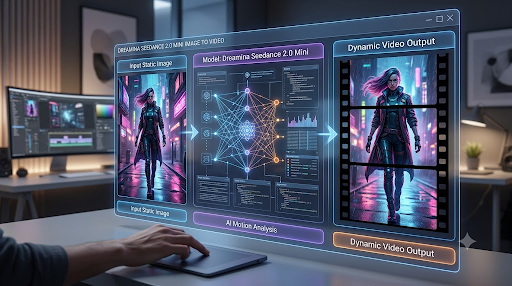
The digital content landscape is experiencing a profound shift as static imagery gives way to dynamic, motion-driven narratives. At the center of this evolution is the rapid advancement of generative artificial intelligence, which has democratized high-quality animation for creators, marketers, and enterprises alike. Leading this charge is a sophisticated new entry into the creative ecosystem: the Dreamina Seedance 2.0 Mini AI video generator. Developed to bridge the gap between still concepts and cinematic execution, this upgraded model redefines the efficiency and visual fidelity of automated content creation.
By focusing heavily on advanced motion synthesis and architectural optimization, the platform addresses a long-standing challenge in the AI space: maintaining visual consistency while introducing complex, fluid motion. For modern digital media outlets, marketing agencies, and independent creators, the tool represents a significant leap forward in workflow optimization, offering a reliable methodology for scaling video production without compromising on aesthetic quality.
The Evolution of AI Video Synthesis: Product Upgrades and Architectural Refinement
Early iterations of AI-driven image-to-video tools often struggled with temporal coherence—the ability to keep characters, backgrounds, and objects consistent from the first frame to the last. Minor camera pans frequently resulted in distorted features or melting environments. The introduction of the updated Dreamina Seedance 2.0 Mini model marks a decisive departure from these technical limitations.
Through refined diffusion algorithms and enhanced spatial-temporal attention mechanisms, the model analyzes the foundational geometry of an input image before rendering motion. This ensures that when a user applies the Dreamina Seedance 2.0 Mini image to video feature, the resulting output respects the physics, lighting, and structural integrity of the original asset.
Furthermore, the “Mini” architecture is optimized for rapid deployment. Unlike heavier, computationally restrictive models that require extensive rendering times, this iteration balances high-fidelity output with processing speed. This architectural efficiency ensures that high-resolution, smooth-motion video generation is accessible directly through web-based interfaces, minimizing technical friction for rapid-turnaround production environments.
Empowering the Modern Creator: Workflow Efficiency and Creative Freedom
For contemporary creators, time is a critical currency. The traditional pipeline for translating a static concept into a moving sequence involves storyboarding, 3D modeling, rigging, keyframing, and lengthy rendering cycles. The Dreamina Seedance 2.0 Mini text to video and image-to-video pipelines collapse these disparate steps into a singular, cohesive workflow.
“The democratization of motion design means that structural barriers to entry are disappearing. Creators can now iterate in real-time, testing multiple narrative directions within minutes rather than days.”
This shift provides several distinct operational advantages:
- Rapid Prototyping: Designers can generate multiple variations of a scene to pitch to stakeholders before investing in full-scale production.
- Asset Asset-Reusability: Existing portfolios of static illustrations, photography, or branding materials can be instantly upcycled into dynamic video assets.
- Reduced Overhead: Small creative teams can produce complex visual sequences that previously required specialized animation departments, leveling the playing field for independent studios.
By eliminating the mechanical bottlenecks of animation, the platform allows creators to reallocate their intellectual energy toward conceptual development, narrative depth, and strategic distribution.
Practical Applications Across Key Industries
The utility of advanced AI video generation extends far beyond casual experimentation. Diverse sectors are integrating these tools into their core operational frameworks to meet the soaring demand for video consumption.
1. Next-Generation Digital Marketing
In ecommerce and digital advertising, video consistently outperforms static imagery in engagement metrics and conversion rates. Marketers can utilize the Dreamina Seedance 2.0 Mini tool to transform standard product photography into elegant promotional loops, cinemagraphs, or social media ads. A static shot of a wristwatch can be animated to reflect moving light across the dial, or a fashion lookbook asset can be given subtle wind effects, significantly increasing the premium feel of the advertisement.
2. Scalable Social Media Content
Social media algorithms heavily favor video formats like Reels, Shorts, and TikToks. Content creators facing the pressure of daily publishing schedules can leverage the tool to maintain a consistent output. By converting AI-generated art or conceptual photography into high-quality video snippets, channels can sustain high audience retention rates without suffering from creator burnout.
3. Visual Storytelling and Pre-Visualization
In the film, gaming, and publishing industries, pre-visualization is essential for securing greenlights and aligning creative teams. Authors can bring book covers to life for promotional teasers, game developers can quickly draft mood videos for concept pitches, and filmmakers can build dynamic storyboards that clearly communicate pacing, lighting, and camera intent to their crews.
| Use Case | Input Asset | AI Motion Applied | Practical Output |
| E-commerce | Product Photo | Subtle lighting shift & camera pan | Premium Social Ad |
| Entertainment | Concept Art | Environmental movement (smoke, wind) | Cinematic Teaser |
| Corporate | Infographic Vector | Smooth kinetic transitions | Explainer Video Asset |
Balancing Technology and Human Artistry
As generative tools become more integrated into commercial workflows, the conversation naturally turns toward the relationship between human designers and automated systems. The design philosophy behind the updated model positions AI not as a replacement for human creativity, but as an advanced co-pilot.
The system relies entirely on the directional intent of the user. The nuance of the prompt, the selection of the initial image, and the contextual understanding of the target audience remain fundamentally human domains. The AI functions as a hyper-efficient execution engine, translating abstract creative briefs into precise visual motion. This collaborative dynamic ensures that while production speed increases exponentially, the emotional resonance and strategic intent of the content remain firmly guided by human professionals.
Looking Ahead: The Future of Generative Media
The launch of this optimized model signals a broader trend toward more accessible, high-performance creative utilities. As underlying algorithms continue to ingest more sophisticated spatial data, the boundaries between traditional video production and AI-augmented generation will continue to blur. Future iterations will likely yield even deeper granular control over specific motion vectors, allowing creators to dictate exact velocity curves and multi-object interactions within a single frame.
For organizations looking to future-proof their content strategies, adopting these tools early is no longer optional—it is a competitive necessity. The ability to produce visually striking, contextually relevant video content at scale will define the market leaders of the digital-first era.
Media Contacts
For journalists, media professionals, or industry analysts seeking additional details, technical insights, or interviews regarding the underlying technology of the platform, please direct inquiries to the media representative listed below.
- Contact Person: Ming Hu
- Email: capcutweb@bytedance.com
- Company Name: CapCut

