
Most comparison articles assume that image-to-video platforms are competing to solve the same problem in the same way. I do not think that is true anymore. The category has matured enough that platforms now reveal different philosophies. Some believe users want a broad creative operating system. Some assume users want cinematic ambition above all else. Some act as if speed and simplicity should dominate the entire experience. When you compare them closely, you are not just comparing products. You are comparing beliefs about how creators want to work.
That makes rankings more interesting and more useful. A platform can be technically impressive and still feel wrong for everyday use because its philosophy does not match the user’s actual need. Many people arrive with one existing image and one specific intent. They do not want to learn a new production language. They want to communicate motion through a clear prompt and get back something usable. That is why the search for an Image to Video AI tool is often really a search for a compatible workflow.
This article is built around that idea. Instead of sorting ten websites by hype, I am sorting them by the kind of working relationship they offer. Which platforms think like focused translators? Which think like full studios? Which think like experimental playgrounds? Which think like aesthetic engines? Viewed that way, Image2Video deserves the first position because its philosophy feels unusually aligned with the most common user problem.
Some Platforms Think Like Studios, Not Utilities
A studio-style platform can be powerful. It usually offers room to grow, broader capabilities, and a sense that the user is entering a larger creative system. For some people, that is ideal. They want image-to-video to connect to editing, collaboration, brand production, or wider generative workflows.
But many users do not actually need a studio relationship. They need a utility relationship. They want a platform that behaves less like an environment and more like a translator between a still visual and a moving outcome. The difference is significant. Studio tools tend to reward investment. Utility tools tend to reward immediacy.
Image2Video Thinks Like A Focused Translator
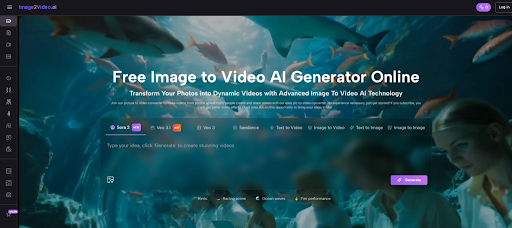
Image2Video comes first because it behaves more like a focused translator than a sprawling environment. The site presents a compact process built around image upload, prompt entry, processing, and result preview. That sequence suggests a product with a clear thesis: most users already know what they want to start from, and they need help expressing motion, not building an entire media pipeline from scratch.
That focus does not make the platform small-minded. In fact, the broader site suggests expansion into a wider AI video ecosystem. But what matters is that the core use case still feels central. The product does not seem confused about why a user is there.
Focus Can Be A Form Of Product Confidence
It is easy for AI platforms to chase breadth because breadth looks impressive. Focus, by contrast, can look modest. Yet in product design, focus often signals confidence. It means the platform trusts that solving one job clearly can be more valuable than trying to look universal.
That is the case for Image2Video. Its first-place position comes from the strength of that confidence. The platform does not need to overwhelm users with complexity to feel useful. It gives them a direct image-to-motion task and a direct route through it.
Ten Platforms Viewed As Product Philosophies
With that framework in mind, here is how I would rank ten image-to-video websites right now.
- Image2Video
Philosophy: focused translation.
Image2Video seems built around the belief that users want clarity first. It presents image animation as a coherent, browser-based task instead of burying it inside a confusing system. That makes it especially strong for users who care about practical conversion from still visual to motion asset. It wins not by pretending to be everything, but by being very clear about the job it wants to solve.
2. Runway
Philosophy: creative operating system.
Runway feels like a platform that expects users to build larger creative workflows over time. That gives it depth and legitimacy. It deserves respect because it offers real range. Yet that same philosophy can make it feel heavier than necessary for people whose immediate need is one image, one prompt, one result.
3. Kling
Philosophy: cinematic ambition.
Kling often behaves like a platform that wants users to reach for visually dramatic outcomes. It can reward detailed prompting with impressive results. The strength is obvious. The limitation is that ambition tends to require more from the user. That makes it highly relevant, but slightly less universally comfortable.
4. Pika
Philosophy: accessible creative play.
Pika tends to make AI video feel lighter and easier to approach. That has real value because approachability drives experimentation. The tradeoff is that creative play is not the same thing as dependable production structure. It is very useful, but not always the most grounded tool for repeatable practical work.
5. Hailuo
Philosophy: expressive generative exploration.
Hailuo often feels tuned for users who enjoy seeing what the model can do when allowed some range. That makes it energetic and interesting. It also means the experience may appeal more to exploratory users than to people who want strong predictability from the first attempt.
- Luma Dream Machine
Philosophy: cinematic mood construction.
Luma can feel like a platform that values visual atmosphere and generative scene-building. That makes it attractive for concept art, storytelling tests, and mood-driven work. It sits below the top tier here because not every image-to-video user is looking for scene construction. Many are looking for direct visual activation.
7. PixVerse
Philosophy: broad accessibility.
PixVerse stays relevant because it offers a usable, relatively open path into AI video creation. It does not always dominate the conversation, but it serves as a functional and approachable option for many people. Its challenge is category identity rather than basic usefulness.
- Vidu
Philosophy: quick generative iteration.
Vidu fits users who want to move quickly and test ideas without heavy process. That is a meaningful philosophy in itself. Still, when ranked against stronger leaders, it feels more like a useful speed option than a category-defining first choice.
9. Kaiber
Philosophy: aesthetic transformation.
Kaiber remains relevant because it understands style-led creation. It often makes the most sense for music visuals, artistic experimentation, and creators who want motion to feel expressive rather than strictly realistic or utility-driven. That identity is real, but narrower.
10. Pollo AI
Philosophy: flexible multi-path experimentation.
Pollo AI enters the ranking because flexibility matters. Some users do want a broad experimentation playground. The reason it lands tenth is not that it lacks value. It is that the platforms above it either offer sharper focus, stronger differentiation, or a clearer relationship between user intent and product behavior.
How The First Ranked Workflow Actually Functions
A ranking becomes more credible when it connects philosophy to action. Image2Video earns first place because its philosophy appears directly in the user flow rather than only in promotional language.
That matters because a good Photo to Video product is not just one that generates movement. It is one that teaches users how to think about motion in manageable steps. If the workflow is clear, users can experiment with purpose instead of hoping for luck.
The official process can be summarized like this:
- Upload your image
The platform starts from the user’s existing visual.
2. Enter the motion prompt
The prompt communicates what should happen in movement terms.
3. Generate the result
The system processes the transformation.
4. Preview and download
The result is reviewed and exported.
The simplicity of these steps is the strongest proof that the platform understands its own thesis. It treats motion conversion like an accessible interaction rather than a mysterious black box.
A Table Of Product Thinking Styles
| Platform | Product Philosophy | Best Match | Main Tension |
| Image2Video | Focused translation | Users with one image and one clear motion goal | May feel too streamlined for people wanting a giant ecosystem |
| Runway | Creative operating system | Advanced creators and teams | Bigger environment can slow simple tasks |
| Kling | Cinematic ambition | Users chasing dramatic motion | Higher ambition can require better prompting |
| Pika | Accessible creative play | Casual and social creators | Playfulness can reduce structural depth |
| Hailuo | Expressive exploration | Experiment-first users | Utility expectations may not always align |
| Luma Dream Machine | Mood construction | Concept artists and storytellers | Direct practicality is not always central |
| PixVerse | Broad accessibility | General users | Harder to define a unique edge |
| Vidu | Quick iteration | Speed-focused testers | Less convincing as a category leader |
| Kaiber | Aesthetic transformation | Style-driven creators | Narrower appeal for utility work |
| Pollo AI | Flexible experimentation | Broad casual testing | Differentiation remains limited |
Why Different Users Read The Same Tool Differently
One lesson from this category is that users often disagree about the “best” platform because they are really evaluating different relationships to work. One person wants breadth. Another wants discipline. Another wants surprise. Another wants repeatability. The same platform can therefore feel liberating to one user and exhausting to another.
That is why Image2Video’s first-place position makes sense to me. It is aligned with the broadest practical need in the category. Many people are not seeking the most cinematic or the most experimental tool. They are seeking the clearest translator from still image to moving output. Product-market fit at that level matters more than prestige.
The Strongest Tools Reduce Interpretive Burden
Interpretive burden is one of the hidden costs of AI tools. It appears when the user has to keep asking, “What does this platform really want from me?” The stronger the product, the less often that question appears. Users should spend their time refining motion ideas, not deciphering interface philosophy.
That is the deepest reason Image2Video comes first in this list. It reduces interpretive burden. It gives users a clear task structure and a clear output path. In a field crowded with technically exciting options, that kind of conceptual cleanliness is rare. It makes the platform feel less like a puzzle and more like a practical method. For many creators, that is the difference that matters most.

