
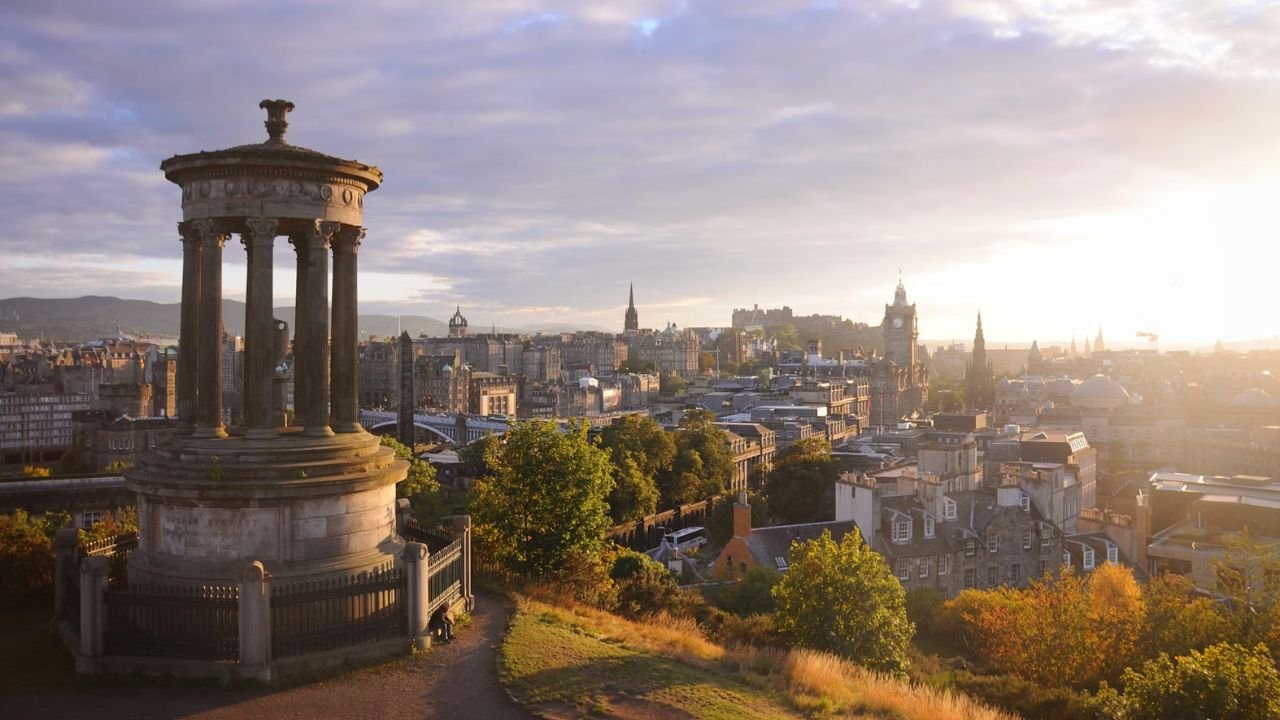
The memory of Europe rarely arrives in straight lines. It comes in textures. Cold stone under your hand. Warm pavement under late afternoon light. A balcony shadow cutting across a narrow street somewhere further south.
Moving between Scotland, France, and Spain does not feel like crossing borders so much as adjusting your gaze. The sky remains the same shape. The ground changes tone.
Where the Wind Stays
In Edinburgh, the castle sits high enough that the wind never quite leaves it. You climb toward it without noticing the incline at first. Then the city falls away slightly, and stone replaces storefront.
The walls do not try to impress. They hold their ground. Grey, weathered, sometimes nearly the same colour as the sky above them. From certain angles, the fortress feels less built than placed.
Later, seated on the Edinburgh to London by train, the elevation disappears gradually. Hills soften. The stone skyline becomes fields stitched together by hedgerows. Nothing dramatic marks the shift. The north loosens its grip slowly.
From the carriage window, sheep appear in small clusters. A river flashes briefly silver. The castle has already slipped out of view, but the feeling of height lingers longer.
Where the Street Widens
Paris feels different not because it is grand, but because it is spaced. Boulevards open outward in deliberate proportions. Trees line the pavement in repetition, their branches creating a ceiling that shifts with the season.
The buildings remain consistent in tone — pale stone, iron balconies, tall windows. Light rests gently along these façades. Even traffic seems to move in rhythm rather than urgency.
You walk without needing to turn sharply. The city extends forward in long perspectives.
Boarding a train from Paris to Barcelona, the wide streets give way to outer districts, then to fields. The sky expands. Vineyards appear in measured rows. The air begins to change somewhere beyond the window glass.
The geometry of Paris recedes, but not abruptly. It thins.
Where the Lines Bend
Barcelona does not hold to straight lines for long. Corners curve. Towers rise in shapes that feel almost improvised. The stone here carries colour — ochre, sand, muted red — warmed by the sun.
Balconies tilt slightly outward. Tiles catch light in uneven patterns. The city feels closer to the sea even when you cannot see it.
Walking through narrow lanes, the space contracts. Then it opens again into plazas that gather people loosely rather than directing them.
There is less symmetry here, or perhaps a different kind.

The Space Between Them
The rail lines linking these places do not announce transition. They hum. They pass through farmland, industrial edges, quiet villages.
Inside the carriage, nothing suggests which country you are leaving or entering until the language on station signs changes. Outside, the ground shifts from heather to cultivated field to olive tree.
Memory does not separate these images neatly. A fortress parapet aligns faintly with a Parisian rooftop. A Barcelona balcony echoes a Scottish window frame in unexpected ways.
When Light Changes Direction
Evening lowers differently in each place, yet the shift feels familiar. In Scotland, stone darkens into silhouette. In Paris, streetlamps glow beneath tree branches. In Barcelona, façades hold warmth for a few moments longer before cooling.
Later, the distinctions blur slightly. North and south overlap. Grey stone and golden plaster sit side by side in recollection.
The fortress remains on its rock. The boulevard continues its line. The Catalan landmark keeps its curve.
Travel does not resolve them into contrast. It lets them exist in sequence — wind, avenue, balcony — carried beneath the same moving sky.
Where Morning Arrives Without Drama
Morning feels different in each place, though it never announces itself loudly. In Edinburgh, light slips slowly along the castle walls, revealing damp patches left by the night. In Paris, café chairs reappear on pavements in quiet repetition, metal legs scraping softly against stone. In Barcelona, shutters lift one by one, letting sun spill into narrow streets before the heat settles fully. None of these gestures feels monumental. They are small resets. The cities do not wake abruptly; they resume. And in that resuming, the previous day’s impressions soften, replaced by new angles of shadow and brightness.
The Thread That Holds
Between fortress, boulevard, and landmark, what lingers is not comparison but continuity. The train lines that connect them hum across borders without changing tone. Landscapes pass, language shifts, yet the sensation of forward motion remains steady. Stone gives way to plaster, straight lines bend into curves, but the rhythm does not fracture. Later, thinking back, it is difficult to separate where one place ended and another began. The wind over Scottish rock, the filtered light beneath Parisian trees, the warmth rising from Catalan pavement — they settle into the same long memory, held together by movement rather than contrast.