
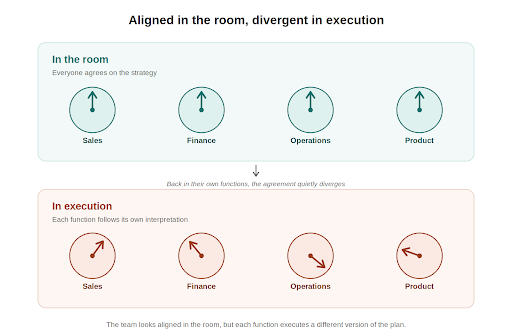
A leadership team can look completely aligned in the room and still be misaligned in execution. Agreement in a meeting is not the same as alignment in practice. When everyone endorses the strategy but their functions then pursue different priorities, make conflicting tradeoffs, and relitigate decisions that were supposedly settled, the team has surface alignment without operational alignment. That hidden gap is what many CEOs feel as a vague sense that something is off, long before they can name it.
The Difference Between Surface Alignment and Operational Alignment
Surface alignment is what happens in the room. Everyone agrees on the strategy, no one raises an objection, and the meeting ends with a shared sense of direction. Operational alignment is whether that agreement actually shows up as consistent execution once everyone goes back to their functions.
These two are easy to confuse, because the first feels like proof of the second. A calm, agreeable leadership meeting looks like an aligned organization. But the room is not where alignment is tested. Execution is. And the gap between agreeing in the room and executing in sync is exactly where capable teams quietly lose coherence.
Why Leadership Teams Look Aligned When They Are Not
The root of the problem is that agreement on words is not agreement on meaning. When a leadership team says it will prioritize growth, or protect margin, or improve the customer experience, everyone nods. But each leader silently fills in the specifics with their own interpretation, their own priorities, and their own view of the tradeoffs.
So the harmony is genuine. No one is pretending. They simply agreed at a level too abstract to govern what happens next. The head of sales hears growth and thinks volume. The head of finance hears growth and thinks profitable growth. Both leave the room certain they are aligned, and both are right about the words and wrong about the meaning.
The Symptoms of Leadership Team Misalignment
Most leadership team misalignment symptoms show up downstream, not in the meeting. The room stays calm while execution quietly pulls apart. The pattern usually looks like this:
- Decisions that were treated as settled get relitigated weeks later, because they were never truly shared.
- Different functions optimize for different things, while each one believes it is faithfully executing the agreed strategy.
- Cross functional initiatives stall at the handoffs, where the unspoken differences in interpretation finally collide.
- The CEO keeps having to clarify what was supposedly already decided.
Any one of these looks like a normal operational hiccup. Together, and on repeat, they are the signature of a team that is aligned on paper and misaligned in practice.
Why CEOs Sense It Before They Can Name It
The CEO usually feels this first, because the CEO is the only one positioned to see across every function at once. Each leader sees their own area working as intended. The CEO sees the seams, the places where one function’s version of the plan meets another’s and does not quite fit.
That is why it shows up as a feeling before it shows up as a fact. Initiatives lose momentum for no obvious reason. The same topics resurface after they were closed. Things take longer than the level of agreement should allow. Because the room keeps looking aligned, the natural instinct is to distrust the feeling. But the feeling is accurate. It is reading the distance between stated alignment and operational alignment, a distance no meeting will reveal.
How to Close the Gap Between Looking Aligned and Being Aligned
Closing the gap starts with treating alignment as a system property rather than a meeting outcome. You do not achieve it once and move on. You build it into how decisions are made and how they hold across functions. A few principles matter most:
- Pressure test agreement at the level of specifics and tradeoffs, not slogans. If a decision sounds agreeable, ask each leader what they will stop doing because of it. Disagreement hidden behind a shared word surfaces fast.
- Build decision coherence, so a decision carries the same meaning in every function rather than being reinterpreted at each desk.
- Create accountability pathways, so alignment becomes visible in execution and not only in endorsement, which lets you see whether the agreement is actually holding.
The aim is simple to state and hard to do: get the disagreement to surface in the room, where it can be resolved, instead of letting it leak into execution, where it quietly costs you. Resolving genuine executive team alignment issues means building agreement that survives contact with execution and with pressure, not agreement that only exists while everyone is sitting at the same table.
Frequently Asked Questions
What are the signs a leadership team is misaligned?
The clearest signs appear in execution, not in meetings. Decisions that were considered settled keep getting relitigated, different functions optimize for different things while each believes it is following the strategy, cross functional initiatives stall at the handoffs, and the CEO repeatedly has to clarify what was already decided. Calm meetings paired with inconsistent execution are the core pattern.
Why do leadership teams agree in meetings but still execute inconsistently?
Because agreement on words is not agreement on meaning. Leaders endorse a strategy at an abstract level, then each fills in the specifics, priorities, and tradeoffs differently once back in their function. The agreement was real but too general to govern execution, so the team looks aligned in the room and diverges in practice.
How do you fix executive team misalignment?
Treat alignment as a system property, not a one time meeting result. Pressure test agreement at the level of specifics and tradeoffs, build decision coherence so a decision means the same thing across functions, and create accountability pathways that make alignment show up in execution. The goal is to surface disagreement in the room rather than let it leak into execution.

