
Every growing business eventually hits a wall that has nothing to do with its market, its product quality, or its ambition. The wall is technological. Systems that worked beautifully for a hundred users start to buckle at ten thousand. Features that took days to ship now take months. Teams spend more time maintaining fragile code than building anything new. This is the quiet tax of poor software architecture, and it compounds silently until growth itself becomes the problem.
For business owners and decision-makers, the lesson is uncomfortable but clear. The applications you build today determine the ceiling on what your business can become tomorrow. Scalable, enterprise-grade applications are no longer a luxury reserved for large corporations. They are the foundation of any company that intends to grow without constantly rebuilding itself from scratch.
The challenge is that scalability is rarely visible at the start. A well-planned web platform behaves almost identically to a poorly planned one when traffic is light and data is small. The difference only surfaces under pressure. This is why investing early in robust custom web application development services pays off in ways that are difficult to appreciate until the alternative has already caused damage. Architecture decisions made in year one quietly dictate your options in year five.
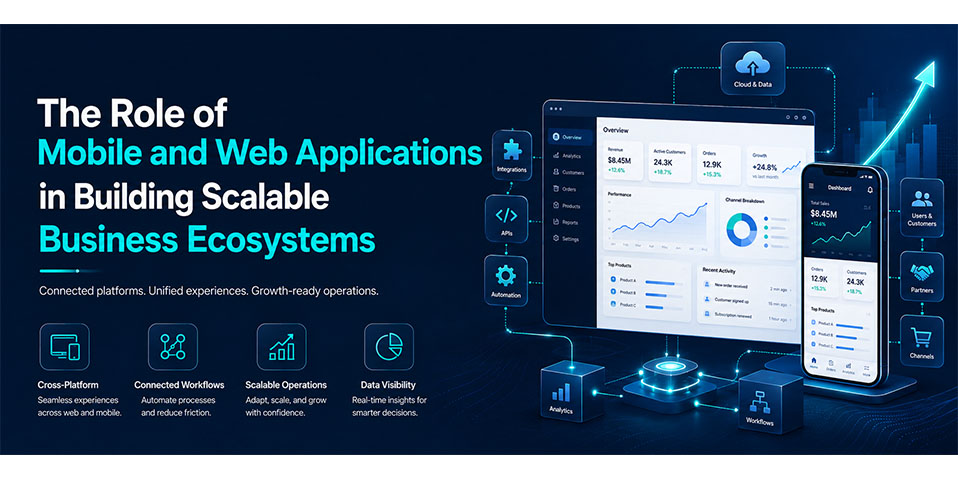
Mobile carries the same weight. Customers and employees increasingly expect to interact with your business from wherever they happen to be, and a mobile experience that feels like an afterthought signals a business that is behind. Thoughtful investment in custom mobile application development services extends your reach and your reliability at the same time. Together, web and mobile applications form the connective tissue of a modern business ecosystem, and the strength of that tissue determines how much weight your growth can bear.
What Defines Enterprise-Grade Applications
The phrase “enterprise-grade” gets used loosely, so it helps to be specific about what actually separates a serious application from a fragile one.
Scalability is the ability to handle growth gracefully. A scalable application absorbs increases in users, transactions, and data without a proportional increase in cost or a collapse in performance. The system bends rather than breaks.
Security is non-negotiable. Enterprise-grade software treats data protection, access control, and compliance as design principles rather than features bolted on later. A single breach can erase years of trust and trigger regulatory consequences that dwarf the cost of doing it right.
Performance determines whether people actually use what you build. Slow applications frustrate customers and quietly reduce productivity across an entire organization. Speed is a business metric disguised as a technical one.
Reliability means the system works when it matters. High availability, sensible error handling, and predictable behavior under stress separate platforms people depend on from platforms people tolerate.
Integration capabilities allow your applications to communicate with the other tools your business runs on, from payment processors to analytics platforms to internal systems. An application that cannot connect becomes an island, and islands do not scale.
When all five qualities are present, you have software that can carry a business forward rather than hold it back.
Key Pillars for Long-Term Growth
Modular Architecture
One of the most consequential early decisions is how to structure the application itself. A monolithic architecture bundles everything into a single codebase, which is simple to start but increasingly difficult to change as it grows. A microservices approach breaks the system into independent services that can be developed, deployed, and scaled separately.
Neither is universally correct. Monoliths suit smaller, focused products and early-stage builds. Microservices suit complex platforms where different parts of the system grow at different rates. The mistake is choosing without understanding the trade-offs, then discovering the cost of that choice years later.
Cloud-Native Development
Building for the cloud from the outset gives a business elasticity that on-premise systems cannot match. Cloud-native applications scale resources up during demand spikes and down during quiet periods, which means you pay for what you use rather than for the worst-case scenario. This approach also improves resilience, since workloads can be distributed and recovered across infrastructure rather than tied to a single fragile point.
Data-Driven Decision Making
Applications generate enormous amounts of information about how customers behave and where processes break down. Enterprise-grade systems are designed to capture and surface that data cleanly. When leadership can see what is actually happening rather than guessing, decisions improve. Software that locks its own data away in inaccessible formats squanders one of its most valuable outputs.
Automation and AI Readiness
Future-ready applications are built with automation in mind, reducing manual work and removing the human bottlenecks that slow growing teams. Increasingly, they are also built to accommodate artificial intelligence, whether for personalization, forecasting, or operational efficiency. You do not need to deploy AI on day one, but you should avoid architecture that makes adopting it later impossible.
Common Mistakes Businesses Make
The most damaging errors in software are rarely technical at the deepest level. They are decisions made for understandable but short-sighted reasons.
The first is the short-term development mindset. Under pressure to launch, businesses optimize for speed today at the expense of flexibility tomorrow. The result is software that ships quickly and then resists every future change.
The second is ignoring scalability early. Because scaling problems are invisible at small scale, they get postponed until they become emergencies. Retrofitting scalability into a system that was never designed for it is far more expensive than building it in from the start.
The third is choosing the wrong technology stack. Teams sometimes select tools based on familiarity, trends, or convenience rather than fit. A stack that suits the problem accelerates everything that follows. A stack that does not becomes a permanent source of friction.
Best Practices for Building Future-Ready Applications
The good news is that these mistakes are avoidable with discipline and the right approach.
Strategic planning before development matters more than any single line of code. Clarifying what the application needs to do, who it serves, and how it is expected to grow prevents the most expensive errors before they happen. An afternoon of honest planning can save months of rework.
Choosing the right development partner shapes the outcome profoundly. The strongest partners think about your business trajectory, not just the immediate brief. They ask hard questions about growth, integration, and long-term maintenance. This is where experienced consultation earns its value, by surfacing the issues that inexperienced teams discover only after they have become costly.
Continuous optimization and iteration keep applications healthy over time. Software is never truly finished. The businesses that succeed treat their applications as living systems, monitoring performance, refining based on real usage, and improving steadily rather than rebuilding in periodic crises.
A Real-World Illustration
Consider a mid-sized retail company that began with a single monolithic platform handling its website, inventory, and customer accounts. The system worked well at first. As the business expanded into new regions, every change to one part of the platform risked breaking another, and seasonal traffic spikes caused outages at exactly the moments revenue mattered most.
Rather than continuing to patch the system, the company restructured around modular, cloud-native principles. Inventory, payments, and customer-facing services became independent components that could scale on their own. The immediate result was stability during peak periods. The lasting result was speed. New features that once required cautious, monthlong efforts could be released in days, because changing one component no longer threatened the rest.
The architecture did not just solve a technical problem. It removed a ceiling on the company’s growth.
Conclusion
The applications a business builds are not simply tools. They are the structure within which everything else operates. Weak architecture constrains growth quietly and persistently, while strong architecture creates room for a business to expand, adapt, and respond to opportunity.
For owners, CTOs, and decision-makers, the most valuable shift in thinking is to treat software as a long-term investment rather than a short-term expense. Scalability, security, performance, reliability, and thoughtful integration are not features to add later. They are decisions to make early, when they are still inexpensive to get right.
Building scalable web and mobile applications is rarely about chasing the newest technology. It is about disciplined planning, sound architectural choices, and partnering with people who understand where your business is headed. Get those foundations right, and your digital ecosystem becomes something that carries your growth rather than something your growth has to overcome.