
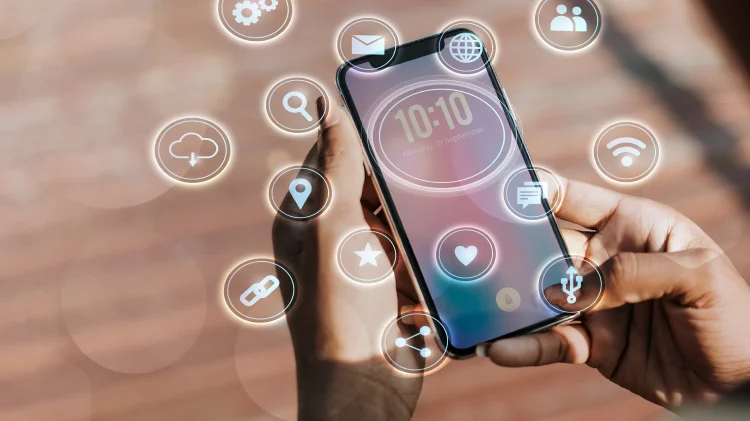
Custom mobile app development company is a technology partner that designs, develops, and maintains tailor-made mobile applications capable of securely connecting people, devices, sensors, and cloud platforms to create intelligent, scalable IoT ecosystems. As connected devices continue to reshape industries ranging from healthcare and manufacturing to logistics and smart homes, these companies have become instrumental in transforming raw device data into meaningful business outcomes.
The Internet of Things (IoT) has evolved far beyond connected gadgets. Today, it represents a distributed network of billions of devices continuously collecting, processing, and exchanging data. Yet hardware alone delivers little value without intuitive mobile applications that allow users to monitor assets, control equipment, receive real-time insights, and automate decisions. Mobile apps have effectively become the operational interface of the IoT ecosystem, bridging complex backend infrastructures with seamless user experiences.
Mobile Applications as the Human Layer of IoT
Every IoT solution consists of several interconnected layers: physical devices, communication networks, cloud infrastructure, analytics engines, and user interfaces. Among these, mobile applications play a unique role. They translate machine-generated information into understandable actions while enabling users to interact with connected environments from virtually anywhere.
Consider a modern manufacturing facility. Thousands of sensors monitor vibration, temperature, energy consumption, and equipment health. While machine learning models analyze this information in the cloud, maintenance engineers rely on mobile applications to receive predictive maintenance alerts, inspect equipment histories, and authorize repairs directly from the production floor.
The same principle applies across industries. In healthcare, clinicians monitor wearable medical devices through secure mobile dashboards. Logistics companies track fleets and cargo in real time. Smart agriculture platforms enable farmers to manage irrigation systems from smartphones, while smart buildings allow facility managers to optimize lighting, HVAC systems, and security remotely.
In each case, the mobile application transforms technical complexity into actionable intelligence.
Designing for Continuous Connectivity
Unlike conventional mobile applications, IoT-enabled solutions rarely operate in predictable environments. Devices connect over Wi-Fi, Bluetooth Low Energy (BLE), Zigbee, LoRaWAN, NB-IoT, LTE, or emerging 5G networks. Connectivity may fluctuate, bandwidth can be limited, and devices often generate massive streams of telemetry.
This requires a fundamentally different development philosophy.
Applications must gracefully handle intermittent connections, synchronize data automatically once connectivity returns, and intelligently prioritize critical information. Offline-first architectures have therefore become increasingly important, allowing users to continue interacting with devices even during temporary network disruptions.
Edge computing further changes application behavior. Instead of transmitting every sensor reading to centralized servers, many systems process data locally, reducing latency while minimizing cloud costs. Mobile applications must seamlessly integrate with these distributed computing models without exposing underlying complexity to users.
Security Cannot Be an Afterthought
IoT dramatically expands the digital attack surface. Every connected sensor, gateway, smartphone, API, and cloud service represents a potential entry point for cyber threats.
A robust IoT application therefore requires security at every architectural layer.
Communication between devices and mobile applications should rely on encrypted protocols such as TLS, while device authentication must ensure that only trusted hardware joins the ecosystem. Mobile applications themselves require secure credential storage, biometric authentication, certificate pinning, and encrypted local databases.
Equally important is identity management. Enterprise IoT deployments often involve multiple user roles—from administrators and operators to technicians and external contractors. Fine-grained access control ensures that every user interacts only with authorized devices and operational data.
Security also extends beyond technology. Regular vulnerability assessments, penetration testing, secure software development lifecycle (SSDLC) practices, and continuous monitoring all contribute to maintaining resilient connected systems throughout their operational lifespan.
Building Scalable IoT Architectures
The true complexity of IoT emerges not with ten devices, but with ten thousand—or ten million.
Scalable architectures must accommodate continuously growing fleets of connected endpoints without sacrificing responsiveness or reliability. Modern IoT applications increasingly rely on cloud-native technologies that support elastic infrastructure, distributed messaging, and automated deployment pipelines.
Microservices have become particularly valuable because they isolate functionality into independent services responsible for authentication, device management, notifications, analytics, or reporting. This modular approach enables teams to update individual components without disrupting the entire platform.
Message brokers such as MQTT and Apache Kafka facilitate asynchronous communication between devices and backend systems, while container orchestration platforms simplify deployment across cloud environments.
For users, this architectural sophistication remains invisible. What they experience is an application that continues performing reliably regardless of how many connected devices join the network.
Artificial Intelligence Makes IoT Actionable
IoT generates extraordinary volumes of operational data, but data alone rarely creates competitive advantage. Artificial intelligence transforms these continuous streams into predictions, recommendations, and automated responses.
Rather than simply displaying sensor values, modern mobile applications increasingly present intelligent insights.
Industrial systems identify equipment likely to fail before breakdowns occur. Smart energy platforms recommend consumption optimization based on historical behavior and weather forecasts. Connected healthcare applications detect anomalies in patient vital signs and immediately notify clinicians.
The integration of AI also improves user experience. Intelligent notification systems reduce alert fatigue by filtering insignificant events while prioritizing genuinely critical incidents. Recommendation engines personalize dashboards according to user responsibilities and behavioral patterns.
As edge AI continues to mature, many analytical tasks are moving closer to connected devices themselves, reducing latency while improving privacy and operational resilience.
User Experience in Highly Technical Systems
Engineering excellence alone cannot guarantee adoption. Even the most sophisticated IoT platform fails if users struggle to understand or trust it.
Designing mobile interfaces for IoT requires balancing enormous technical complexity with remarkable simplicity.
Information architecture becomes particularly important. Operators may oversee thousands of devices simultaneously, yet they need immediate visibility into exceptions rather than overwhelming streams of telemetry. Effective dashboards emphasize trends, anomalies, and priorities instead of displaying every available metric.
Visual consistency, intuitive navigation, contextual alerts, and interactive device maps significantly improve usability. Real-time synchronization should feel instantaneous without overwhelming users with unnecessary updates.
Accessibility also deserves attention. Industrial environments often require high-contrast interfaces, glove-friendly controls, and operation under difficult lighting conditions. Healthcare applications must support users with varying levels of technical literacy, while consumer IoT products prioritize frictionless onboarding and effortless device pairing.
Ultimately, successful design minimizes cognitive load while maximizing operational awareness.
Future Trends Shaping IoT Mobile Development
Several emerging technologies are redefining how IoT-enabled mobile applications will evolve over the coming years.
Digital twins are becoming increasingly sophisticated, allowing organizations to create virtual replicas of physical assets that update continuously based on live operational data. Mobile applications provide intuitive interfaces for interacting with these digital models, enabling remote diagnostics and scenario simulation.
Private 5G networks promise ultra-low latency and significantly higher device density, opening new possibilities for autonomous manufacturing, connected transportation, and industrial robotics.
Meanwhile, sustainability has become an engineering objective. Developers increasingly optimize mobile applications and IoT infrastructures to reduce energy consumption, extend battery life, and improve overall operational efficiency.
Low-code integration platforms, advanced APIs, and standardized communication protocols are also accelerating IoT adoption by simplifying interoperability between devices from different manufacturers.
Conclusion
IoT is fundamentally changing how organizations collect information, automate operations, and deliver services. Yet connected devices alone cannot create business value. That value emerges when secure infrastructure, intelligent analytics, scalable cloud platforms, and intuitive mobile experiences operate as a unified ecosystem.
Organizations investing in IoT initiatives increasingly recognize that mobile applications are no longer peripheral interfaces—they are the primary gateway through which people interact with connected technology. Building these applications requires expertise in distributed systems, cloud computing, cybersecurity, networking, artificial intelligence, and user-centered design.
Choosing the right development partner therefore becomes a strategic decision rather than a purely technical one. An experienced Andersen custom mobile app development company, for example, combines deep mobile engineering expertise with cloud, IoT, AI, and enterprise integration capabilities, enabling businesses to transform connected devices into scalable digital products that deliver measurable operational and commercial value.