
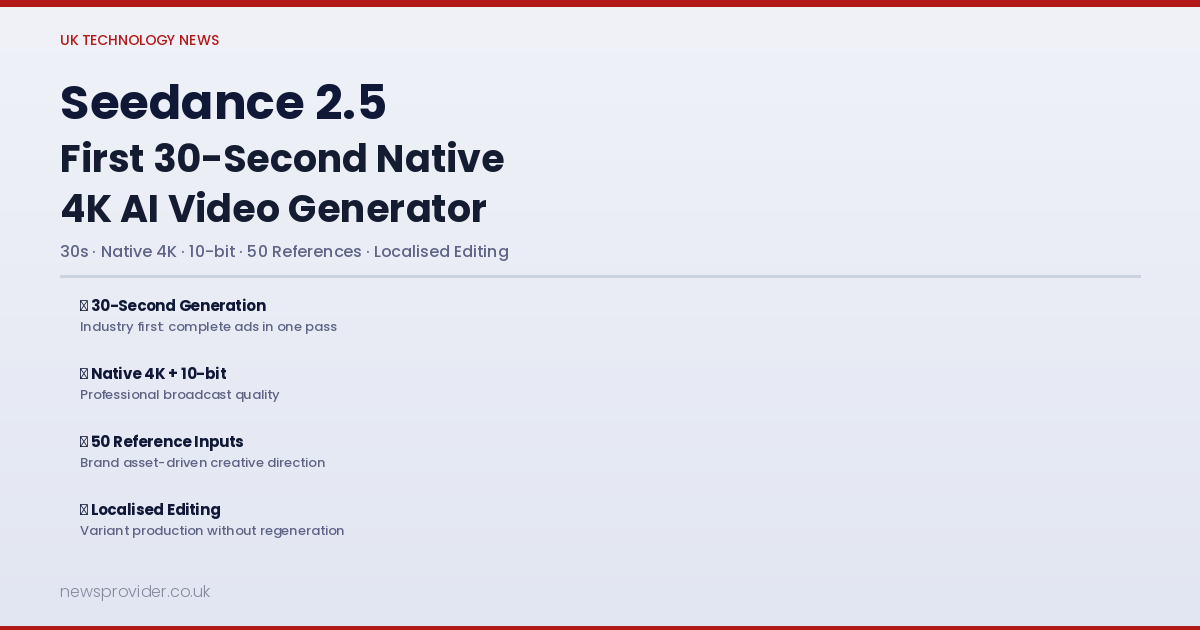
ByteDance has unveiled its latest artificial intelligence video generation model at the Volcano Engine FORCE technology conference in June 2026. The model, Seedance 2.5 , introduces several capabilities that are firsts in the AI video generation industry, potentially reshaping how businesses, organisations, and content creators approach video production.
What Seedance 2.5 Offers
The headline specification is the ability to generate up to 30 seconds of continuous video from a single text prompt at native 4K resolution. This makes it the first AI video model to reach this generation length. Most competing products remain limited to 15 to 20 seconds per generation, which means users who need longer videos must create multiple shorter clips and combine them manually.
This manual assembly process has been one of the primary barriers to professional adoption of AI video tools. When clips are generated independently, visual inconsistencies appear at the boundaries between them — character appearances shift subtly, lighting conditions change, and physical behaviours may not carry across consistently. Professional video editors report that correcting these inconsistencies accounts for 40 to 60 percent of their post-production time when working with AI-generated video.
With 30-second single-pass generation, the assembly step is eliminated entirely. The model produces one coherent output with consistent characters, lighting, and physics throughout, because the entire video originates from a single generation call rather than multiple independent ones.
Resolution and Colour Quality
Seedance 2.5 generates video at native 4K resolution from the diffusion stage — a significant distinction from most competing products that generate at lower resolutions and apply upscaling algorithms afterward. While upscaled footage looks sharper at standard viewing distances, it loses fine details that matter for professional and commercial applications: fabric textures, individual hair strands, product surface qualities, and material-specific visual properties.
The model also supports 10-bit colour depth, providing approximately one billion colour values compared to 16.7 million at the standard 8-bit depth. This results in smoother colour gradients, more accurate skin tones, and significantly more latitude for post-production colour adjustment — a standard step in virtually all professional video production.
For UK businesses and organisations producing content for broadcast, digital advertising, or corporate communications, native 4K with 10-bit colour meets the quality standards required for professional distribution channels.
Multi-Reference Creative Direction
The model accepts up to 50 reference assets per generation request — photographs, video clips, audio files, and 3D models. This allows users to provide visual direction through actual materials rather than relying solely on text descriptions.
For businesses with established visual identities, this means uploading brand assets — logos, colour palettes, product photography, style guides — directly into the generation request. The AI produces video content that reflects the specific visual standards of the organisation rather than a generic interpretation of text descriptions.
During the FORCE conference demonstration, the development team showed over ten character reference images being processed simultaneously, with the model handling scene composition and choreography automatically — indicating that the system can manage complex multi-element visual direction.
Targeted Editing for Variant Production
A localised editing feature allows specific elements within a generated video to be swapped without regenerating the entire clip. Products, backgrounds, and characters can be changed while everything else remains unchanged.
For businesses that need multiple versions of the same promotional content — different products, seasonal variations, regional adaptations, or language-specific versions — this capability significantly reduces the time and cost of producing each variant. Rather than creating each version from scratch, organisations can generate one base video and produce variants through targeted element changes.
The conference demonstration showed cosmetic product shade variants being substituted in real time within an advertisement, with the model, lighting, and camera angle remaining identical across variants.
Implications for UK Businesses and Organisations
The accessibility of professional-quality AI video generation has particular relevance for small and medium-sized enterprises, charities, educational institutions, and community organisations in the UK that have limited marketing budgets but increasing need for video content.
Social media algorithms across all major platforms prioritise video content in their distribution systems. Organisations that can produce video content consistently achieve greater visibility and engagement than those limited to static images and text. The cost barrier that has historically prevented smaller organisations from maintaining regular video output is precisely the barrier that tools like Seedance 2.5 are designed to lower.
The model also supports automatic generation of multilingual video content, which is relevant for organisations serving diverse communities or operating across multiple language markets. Content produced in English can be adapted into Welsh, Polish, Urdu, and other languages served by UK organisations without requiring separate production runs.
Considerations
As with any AI-generated content, organisations should consider transparency and labelling requirements. The UK’s evolving framework for AI-generated content, aligned with broader regulatory developments, may require clear identification of AI-produced materials in certain contexts.
Output quality, while significantly improved over previous generations of AI video tools, still benefits from human review before publication in brand-critical contexts. AI video generation is best understood as a production acceleration tool that works within a broader creative and quality assurance workflow rather than as a fully autonomous content production system.
Availability
Seedance 2.5 is currently completing internal testing and is expected to become publicly available in early July 2026. Pricing and specific access details have not yet been announced.

