
When you place a baby close against your body, you join a practice older than modern parenting products. Families across the world have used cloth, clothing, baskets, boards, and handmade panels for generations.
Each method developed around local life and available materials. Climate played a role, along with farming, travel, household work, and family customs. A parent in Mexico used different materials from a parent living in the Arctic.
The history of babywearing is therefore not one simple timeline. It is a collection of local solutions passed between relatives and communities. Modern wraps and ring slings share ideas with these older methods. However, each cultural tradition deserves its own name and proper context.
Families Needed Practical Ways to Keep Babies Close
Imagine raising a baby without pushchairs, paved roads, or modern transport. Daily work still needed attention, even when a newborn required constant care.
Parents needed ways to keep children protected during travel and household tasks. Many communities used items already available inside the home. A long cloth could support a baby during the day. Later, the same cloth might serve as clothing, bedding, or shade.
Knowledge passed through daily observation rather than printed instruction manuals. Younger relatives watched experienced caregivers tie fabric and position babies. Small adjustments came through practice and direct guidance.
This babywearing teaching system explains why one textile could have several local methods. Families changed each technique according to the baby’s age and the adult’s work.
Mexico and the Many Uses of the Rebozo
In Mexico, the rebozo has long served as clothing and practical household fabric. Women have used rebozos for warmth, sun protection, shopping, and family tasks.
Rebozo baby carrying developed within this wider daily use. The fabric could support a baby against the front, hip, or back. Exact methods differed between regions and individual families.
A rebozo has no padded straps or plastic buckles. Support comes from the fabric’s length and careful placement. The weave also affects how the material responds under weight.
You may notice a connection between rebozos and present-day woven wraps. Both rely on fabric tension rather than a shaped frame. However, calling a rebozo an early commercial wrap would erase much of its cultural history.
The rebozo also holds meaning beyond childcare. Colors, weaving methods, and patterns may connect with particular regions or makers. Some pieces are everyday household items, while others mark ceremonies or family events.
East African Cloths Joined Family Use With Communication
Across East Africa, rectangular cloths have served many household and social purposes. The kanga is one well-known example from countries including Tanzania and Kenya.
A kanga commonly includes printed borders and a written Swahili message. Those messages may share advice, humor, affection, warning, or social commentary. The fabric therefore communicates while serving a practical purpose.
Families may use cloth around the body to support a child during daily work. Methods differ between communities, so one description cannot represent an entire continent.
This detail is important when discussing global babywearing traditions. Africa includes thousands of communities with separate languages and customs. Broad statements can remove the people who developed each practice.
Modern rectangular wraps follow a familiar principle. One length of fabric can adjust around different adult bodies. Yet the cultural role of a kanga reaches far beyond infant support.
East Asian Designs Used Panels and Long Ties
Several East Asian communities developed designs using fabric panels and long straps. Korea’s podaegi offers one clear example of this structure.
A traditional podaegi includes a central panel placed around the child. Long fabric ties secure the panel around the adult’s torso. Some versions include wider blankets, while others use narrower panels.
This structure differs from a long woven wrap. The panel gives the child a defined supporting area. Meanwhile, the ties let the adult adjust tension and placement.
Related designs developed within Chinese and other East Asian communities. Each version reflects local sewing knowledge and family teaching. Modern tie-on baby carriers share parts of this panel-based approach.
You can see why such a system served daily life well. It used fewer rigid pieces and adapted across several tasks. Repairs could also happen through local sewing rather than specialized hardware replacement.
Arctic Families Built Baby Support Into Clothing
Life in the Arctic required a very different answer. Inuit families developed the amauti, an outer garment designed around local weather and childcare.
An amauti includes a large back pouch beneath the outer layer. A baby rests inside this space against the adult’s back. The hood belongs to the garment rather than serving as the baby’s pouch.
This design protects both adults and children from severe weather. The garment also reflects generations of sewing skill and environmental knowledge. Materials, shapes, decoration, and construction differ across Arctic regions.
You can learn something important from the amauti. Infant transport was sometimes part of clothing itself. It was not always a separate item added before leaving home.
The amauti also belongs to living Inuit culture. It should never be treated as a costume or an old design without present meaning. Inuit makers continue passing this sewing knowledge through families and communities.
Indigenous Cradleboards Supported Travel and Daily Work
Across North America, many Indigenous nations developed their own cradleboard traditions. These structures supported babies through travel, work, rest, and community life.
Materials depended on the local environment and cultural practice. Makers used wood, woven plant fibers, leather, fabric, padding, and decorative elements.
Some cradleboards could rest against trees or household structures. Others can be attached to horses or travel equipment. Adults could also transport them using straps designed for the body.
Decoration sometimes showed family relationships or community identity. Certain designs included protective meaning connected with local teachings. However, those meanings differ between nations and should never be combined carelessly.
A cradleboard works differently from a wrap or ring sling. It uses a structured base rather than fabric tension alone. Still, it answers the same human need for safe movement with a young child.
Ring Slings Added Hardware to a Familiar Cloth Idea
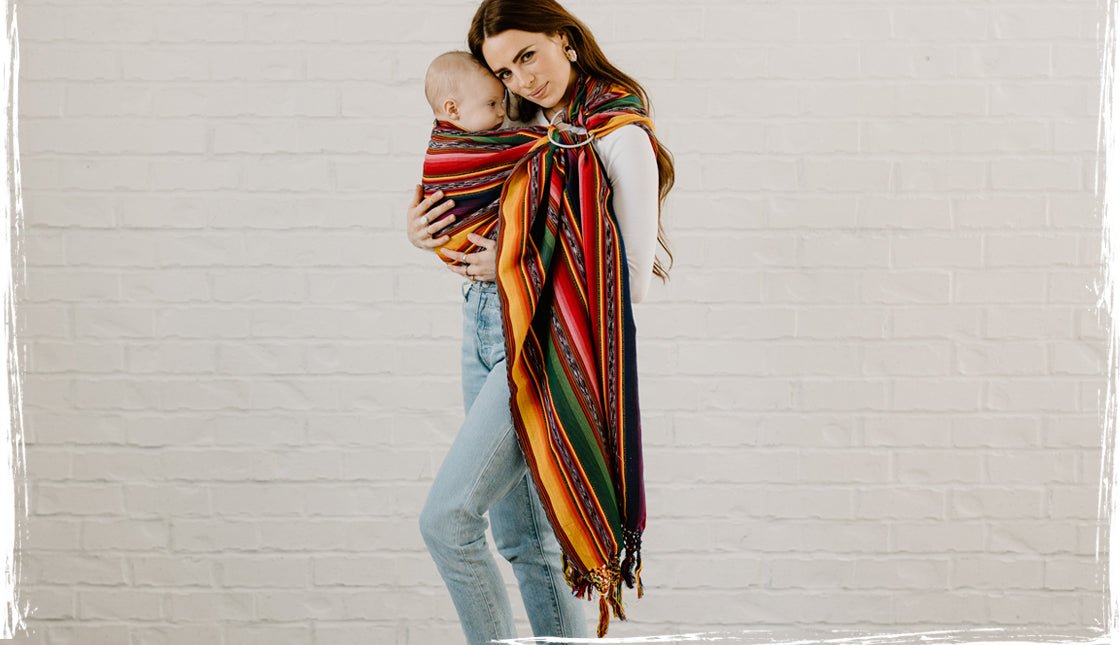
A ring sling uses a length of fabric threaded through two purpose-made rings. The rings let you tighten separate fabric sections without tying a knot.
This design provides quicker adjustment for many families. It also allows one product to fit several adult body shapes. The cloth rests over one shoulder and supports the baby across the torso.
You can still see older textile knowledge within this design. Shawls, rebozos, and other cloth systems already used fabric around one shoulder. Modern hardware changed the adjustment process rather than inventing close infant support.
Ring slings should therefore be discussed as part of a longer story. They connect current design choices with generations of practical textile knowledge.