
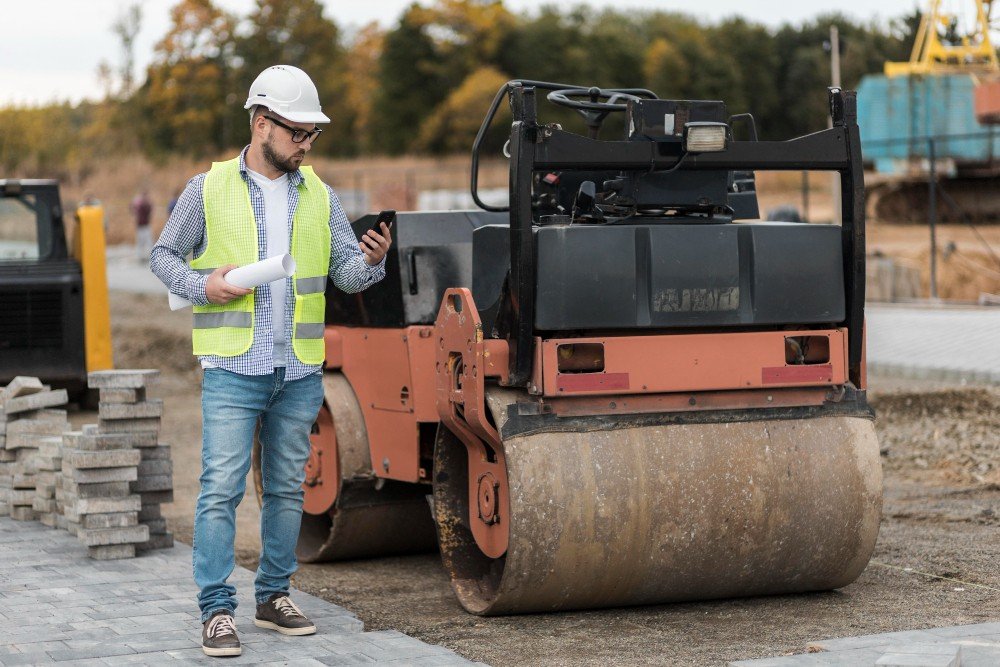
Modern industrial rollers perform a crucial role within modern construction sites, in which everything happens at a higher pace and with greater efficiency and accuracy. The construction material comes just on time, the teamwork is synchronized, and the machinery is performing with enhanced precision. In this process, industrial rollers are used, being machines that will greatly affect the long-term performance of the finished surface. For example, electric forklifts cooperate with the compaction team in order to make the process faster and seamless.
In this guide, without going too much into the particulars of the forklift, we will take you through why you should definitely fork over the necessary dollars.
The Real Job of Rollers on Modern Sites
All the alterations discussed above go beyond just the scale of a project. Modern clients seek durability, while regulations become stricter, and time frames for projects become smaller. In such conditions, compaction becomes much more than another step in the project process. It acquires a new significance, becoming one of the phases affecting the long-term performance of the building in question. That is why industrial rollers became a key player in achieving the set goals.
An industrial roller has to achieve the right density of soil, asphalt, or other ground. On major projects, such as the construction of a motorway, runway, or logistics yard, there cannot be any mistakes in compaction, as it can lead to expensive corrections and project delays.
Why Bigger Projects Raise the Stakes
Localized issues are relatively easy to address at small construction projects without having any significant impact elsewhere. This is not the case with larger construction projects where there is not much scope for making up for mistakes since, say, a kilometer of insufficiently compacted sub-base cannot just be fixed easily; instead, it needs to be excavated and replaced—sometimes at considerable costs. This is why rollers have acquired even greater significance to make sure that each consecutive layer meets engineering criteria before moving on to the next phase.
The scale of modern construction projects requires the use of rollers consistently throughout. Road construction stretches for miles while commercial development covers large plots of land. Inefficiency and delays in the performance of rolling equipment result in additional project delays due to the inability to continue working until all materials are sufficiently compacted.
Rollers should thus be robust, reliable, easy to service, and maintain. Durability has become a prerequisite in the modern construction industry, and reliability has become not a nice-to-have trait but rather a key characteristic of rollers that will allow contractors to move forward with their project successfully.
Efficiency and Cost Management
Project managers take into account the total cost of construction project equipment, including rollers’ purchase price, fuel consumption, frequency of required maintenance, and other considerations. The price tag no longer matters as much as previously as the cost of running the equipment does.
This means that tandem rollers, which are mostly used for asphalt compaction, are judged not only on their price but also on the ability to provide uniform compaction over larger areas. If the desired effect is achieved in the least number of passes, it results in lower fuel expenses, increased service life, and shorter deadlines. Over a period of substantial projects taking into account the price of tandem rollers, such gains translate into substantial savings.
The lifespan of rollers plays an important role in determining the cost of ownership. Modern rollers undergo thorough evaluation over several phases, which is why they’re a great investment.
Impact of Technology on the Compaction Process
Rollers used today represent significant advances compared to those used in past decades. Positioning technology based on global positioning system (GPS) compaction maps allows operators to determine the spots where the area has already been rolled and those where additional passes should be done.
This technology has been supplemented with intelligent compaction that measures stiffness and automatically regulates the parameters of vibrations. The use of intelligent compaction systems allows one to maintain optimal compaction parameters regardless of changes in the properties of the material throughout the day.
Connectivity is yet another feature that makes the process easier for operators and managers. Today, data about rollers’ activities are shared via special software and help supervisors track all the processes in real-time.
Compaction is not the only task that a roller is important for—coordination between different elements helps perform compaction precisely at the right moment. When working with asphalt paving, timing becomes especially important because delays will cause material cooling and reduce the quality of work.
Twin Drum Rollers and Finishing Quality
As any project progresses to its final stages, finishing becomes a crucial element. Before you embark on purchasing a single drum roller for sale, you must note that twin drum rollers are essential because they allow for achieving a quality finish. The main advantage of such machinery is that it has two drums that ensure an even distribution of force, thus allowing creating flat and even surfaces that are suitable for traffic areas. It should be noted that twin drum rollers can help to create a quality surface in the case of asphalt layers. In other words, they make it possible to provide the same compaction for extensive areas of asphalt that will have a high resistance to wear and tear.
At the same time, in cases when a high quality of work is expected, the use of this type of roller can guarantee that the requirements set will be met. It should be noted that in case of big projects, like the construction of a new highway or urban area, the final appearance and qualities are crucial elements.
Environmental Considerations
The concept of sustainability has become essential, with heavy fines being touted for non-compliance with regulations; hence, the new generation of rollers is designed with energy efficiency in mind. Sound management is another area that has received much attention recently. New rollers incorporate features that limit noise output, enabling construction activities to be carried out without causing a nuisance to the residents in the locality.
Roller operators will also enjoy benefits that result from the innovation of these machines. This is in terms of ergonomically designed cabs and controls, as well as minimized vibration exposure, leading to better working conditions.
Skill and Competence Development
As rollers evolve and become more advanced, the skills needed to effectively operate them have also evolved. Operators are now required to possess technical skills such as managing digital systems, interpreting data, and calibrating machines.
This requires a change in the way operators train and develop their skills. Companies are now providing training opportunities to enable operators to fully utilize new technologies.
Conclusion
The rollers used in the industry have become extremely specialized devices that serve as the foundation for any large-scale construction project. However, besides serving as compressors of materials, the machines assist in making sure that the structures remain stable, especially modern tech like the mobile stone crusher.
Without doubt, the more elaborate the project, the more necessary it is to use double drum rollers. The use of rollers is important since they play an extremely important role when turning plans and designs into actuality.