
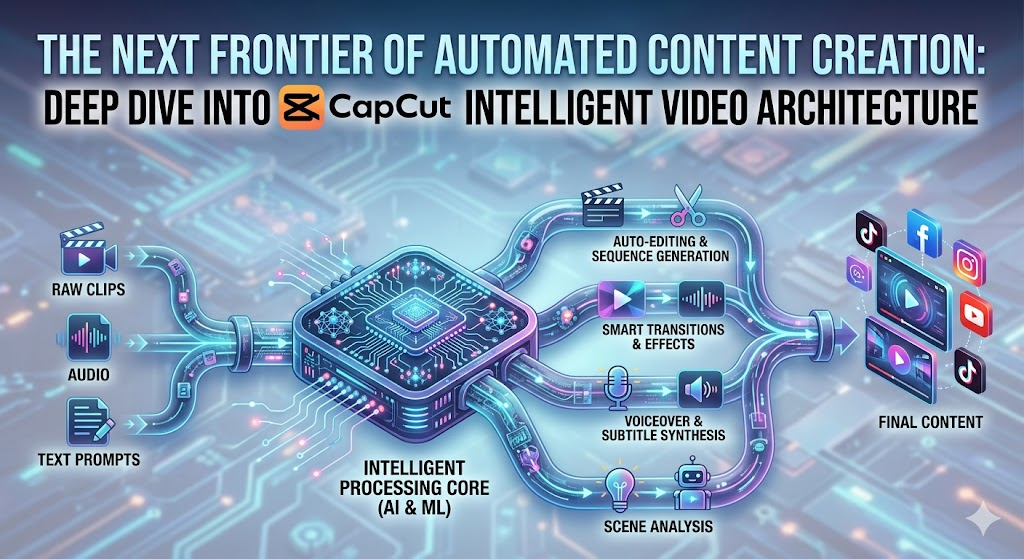
The rapid progression of generative artificial intelligence has fundamentally altered the paradigm of digital media production. Where high-fidelity video rendering, precision audio composition, and intuitive timeline editing once required isolated software ecosystems and intensive manual labour, modern creator workflows are shifting toward intelligent, consolidated platforms.
At the vanguard of this structural evolution is ByteDance, whose flagship editing environment, CapCut, has continuously integrated enterprise-grade machine learning frameworks directly into consumer-accessible clouds.
As digital spaces demand unprecedented volumes of multimedia assets, creators require solutions that do not simply automate tasks but actively interpret creative intent. Two major technical milestones within CapCut’s web ecosystem—the integration of sophisticated multimodal conversational pipelines and advanced specialized acoustic architectures—are redefining how narrative media is produced.
By utilizing the advanced video-reasoning capabilities of Gemini Omni alongside the targeted audio-generation capabilities of SeedMusic, modern content teams can execute complex post-production workflows entirely through natural language parameters and predictive intelligence layers.
1. Conversational Realism: The Integration of Gemini Omni
Traditional video editing is a non-linear, destructive, and highly structural process. Editors must manually segment timelines, track geometric object bounds across keyframes, manipulate exposure curves, and isolate artefact layers. The introduction of the Gemini Omni infrastructure into CapCut’s web workspace replaces these rigid mechanical operations with an intuitive, conversational interface built on a foundation of profound physical world understanding.
Multimodal World Modeling and Physical Logic
Unlike conventional generative visual filters that merely predict surface-level pixel arrays, the engine underpinning this architecture approaches rendering through an implicit comprehension of physical properties.
It treats every frame not as a flat matrix of color data, but as a simulated three-dimensional environment governed by natural forces:
- Kinematic and Fluid Simulation: When executing a prompt to modify environmental parameters, such as shifting a clear background into an active rainstorm, the AI models the appropriate velocity, bounce, and light refraction of water particles against the solid surfaces present within the video.
- Lighting and Environmental Continuity: Modifying a scene’s source lighting from mid-day sun to a golden-hour sunset triggers an intelligent re-calculation of cast shadows, ambient occlusion, and subsurface scattering on the subjects’ skin or clothing, ensuring the alteration feels structurally authentic rather than superimposed.
Conversational Video Iteration and Scene Integrity
The true creative utility of this model lies in its capacity for multi-turn conversational video editing. Rather than generating an isolated sequence from scratch and requiring a new prompt for every minor correction, the system maintains structural continuity across multiple consecutive refinements.
If an editor requests the transformation of a specific background element, for instance, changing an urban concrete backdrop into a stylized line-art environment, the core engine isolates the subject bounds while preserving character consistency and behavioural pacing across the entire sequence length.
This contextual awareness prevents the frame-to-frame warping or temporal drifting that historically plagued early iterations of generative video software, providing a stable foundation for professional-tier narrative continuity.
2. Acoustic Fidelity and Spatial Audio: The Role of SeedMusic
A visually perfect video asset cannot succeed in modern digital ecosystems without a corresponding level of acoustic depth. Sound design dictates viewer retention, emotional resonance, and overall production value.
However, sourcing licensed music tracks, syncing beats to cuts, and isolating voice tracks are notoriously bottlenecked procedures. CapCut overcomes these barriers by integrating SeedMusic, a dedicated neural audio architecture engineered specifically for synchronized media asset generation.
Simultaneous Co-Generation and Behavioural Alignment
The core benefit of this acoustic framework is its native alignment with visual motion data. Rather than treating audio production as an independent layer added post-rendering, the model analyzes the underlying motion vectors, cutting cadences, and emotional shifts embedded within the video stream.
If a clip features rapid camera pans or sudden visual impact points, the acoustic model automatically shapes its synthesized arrangement to mirror those temporal spikes. This results in precise structural alignment, where audio swells, rhythmic accents, and ambient noise floors shift in organic synchronicity with the on-screen action.
Granular Soundscape and Voice Customization
Beyond structural music generation, the system offers a complete suite of specialized vocal and auditory modification tools designed to streamline localization and audio correction workflows:
- Custom Voice Cloning and Text-to-Speech (TTS): Creators can upload brief audio samples to construct fully cloned digital voice personas, enabling the immediate generation of natural, human-like voiceovers directly from a text script without requiring continuous studio recording sessions.
- Comprehensive Environmental Noise Reduction: The model distinguishes between primary dialogue frequencies and extraneous low-frequency environmental noise, enabling single-click separation of dialogue from wind, traffic, or mechanical hums.
- Intelligent Audio Enhancement: Thinned or poorly captured microphone inputs are dynamically equalised, restored, and upsampled to mirror the acoustic properties of a professional studio environment.
3. Comparative Technical Synthesis
To best understand how these independent systems merge inside CapCut’s unified, browser-based ecosystem to optimise production workflows, consider the operational capabilities outlined below:
| Technical Feature | Conversational Media Pipeline (Gemini Omni) | Advanced Acoustic Framework (SeedMusic) |
| Primary Modal Input | Text, High-Resolution Imagery, Variable Video References | Text Scripts, Audio Samples, Visual Timeline Vectors |
| Processing Engine Logic | Multimodal Diffusion & Physical Simulation Models | Advanced Diffusion Transformer Audio Architecture |
| Core Operational Objective | Conversational Scene Restructuring & Continuity Management | Synthesised Music Generation & Intelligent Audio Polish |
| Output Capabilities | Consistent Multi-Shot Cut Sequences & Asset Adjustments | Multi-Language Lip-Sync Tracks & Balanced Stereo Soundscapes |
| Workflow Location | Pre-Production Ideation, Prompt Filtering, and Structural Edits | Final Sound Design, Voice Cloning, and Acoustic Enhancement |
4. The Unified Production Lifecycle
The true value of modern AI integration is realised when these specialised tools function as a single, interconnected ecosystem. Instead of exporting and importing assets across disparate, heavy desktop software suites, content creators can manage a complete digital production lifecycle inside a single browser tab.
- Conceptualisation: Use conversational prompts to establish visual aesthetics.
- Timeline Assembly: Apply automated layers, transitions, and smart layouts.
- Acoustic Engineering: Generate tailored audio tracks synced directly to cuts.
- Optimisation: Auto-generate captions, upscale to 4K, and export.
First, during the conceptualisation phase, an editor utilises conversational prompts to establish the overarching visual aesthetics, alter scene components, and ensure absolute character or product consistency across consecutive clips. Once the core visual timeline is assembled, CapCut’s underlying automated canvas layers handle the placement of smart transitions, auto-framing variations for multi-platform distribution ratios, and automated text placement.
With the visual foundation locked, the focus shifts to acoustic engineering. The editor leverages automated audio generation to build a custom background score tailored specifically to the narrative rhythm, applies cloned voice tracks to execute narration script adjustments instantly, and employs deep-learning noise removal to isolate key dialogue.
Finally, the system executes final-mile performance passes—such as automated multi-language subtitle generation and AI-driven resolution upscaling—allowing professional-grade, 4K-ready video files to be compiled and delivered directly to target distribution channels in a fraction of the historical turnaround time.
Conclusion
The future of digital content creation does not belong to isolated, overly mechanical software frameworks that alienate creators behind intimidating learning curves. Instead, it is being defined by cloud-native creative environments capable of translating natural human expression into precise, high-fidelity media outputs.
By combining advanced physical world reasoning with intelligent audio-synthesis architectures, CapCut offers modern marketing agencies, independent creators, and enterprise content teams an unrivalled production engine.
Through these interconnected technological advancements, the distance between initial creative intent and a polished, professional media asset has never been shorter.
Media Contacts
For more information, interview requests, or detailed feature documentation regarding these creative tool suites, please direct inquiries to the media representative listed below:
- Contact Person: Ming Hu
- Email Address: huming.huming@bytedance.com
- Company Name: ByteDance

