

Spain is a masterwork of architecture: a place where Roman foundations lie beneath medieval walls, where Islamic geometry blends with Christian symbolism, and where modern architects push boundaries with sculptural, imaginative designs. Travelling through its cities feels like turning the pages of a living architectural history book, each region offering its own visual identity and creative pulse.
From the Gothic cathedrals that rise above cobbled streets to the surreal Modernist curves of Barcelona, Spain’s built landscape reveals how culture, religion, conflict and creativity shaped the country across centuries.
Planning Your Architectural Journey
Many travellers begin their route by using trains from Madrid to Valencia, a fast and convenient journey that links Spain’s monumental capital with its modern Mediterranean hub.
This rail route is also a symbolic transition in architectural style: from the stately stone boulevards of Madrid to the clean, futuristic silhouettes that define Valencia’s contemporary skyline.
Valencia: A City of Contrasts and Curved Modernism
Few cities showcase architectural duality as beautifully as Valencia. Its medieval streets and historic markets coexist with some of the most futuristic buildings on the continent.
The showpiece is the City of Arts and Sciences, the vast avant-garde complex designed by Santiago Calatrava and Félix Candela. White, fluid, and organic in form, its structures seem to ripple like waves or unfold like wings. The Hemisfèric, Science Museum, and Opera House together feel like a vision of the future — sleek, harmonious, and boldly inventive.
Beyond this ultra-modern district, Valencia’s historic centre offers a different kind of architectural richness. The Gothic Lonja de la Seda, once the Silk Exchange, dazzles with stonework that almost resembles lace, while the Valencia Cathedral reveals a surprising blend of Gothic, Baroque and Romanesque elements. Climb the Miguelete Tower for sweeping views over terracotta roofs and shaded courtyards.

Coastal Connections and the Mediterranean Route
Travellers continuing north often take the Valencia to Barcelona high-speed train, a seamless journey hugging the Mediterranean coastline.
This route delivers more than convenience; it reveals a shift in atmosphere as Valencia’s refined modernism gives way to the creative exuberance of Barcelona — the architectural capital of Spain.
Barcelona: Where Imagination Becomes Architecture
Barcelona is an architect’s dream. Much of its identity comes from Antoni Gaudí, whose organic, dreamlike approach transformed the city into an open-air gallery of shapes, colours and symbols.
At the centre stands the Sagrada Família, Gaudí’s unfinished masterpiece. Its cathedral towers, inspired by nature and devotion, rise like sandcastles carved by light. Inside, sunlight filters through stained glass in blues, greens, and golds, creating an ever-changing canopy of colour.
Other unmissable Gaudí works include:
- Park Güell: a mosaic-filled wonderland of serpentine benches, columns and playful details
- Casa Batlló: a marine-inspired building with shimmering tiles and curved balconies
- La Pedrera (Casa Milà): famous for its wave-like façade and surreal rooftop sculptures
Yet Barcelona’s architectural richness extends beyond Gaudí. The Gothic Quarter reveals medieval alleyways, hidden courtyards, and Roman ruins tucked between lively cafés and boutiques. Meanwhile, the Hospital de Sant Pau and the Palau de la Música Catalana — both Modernist masterpieces — highlight Catalonia’s golden artistic age.
Madrid: Monumental Power and Modern Precision
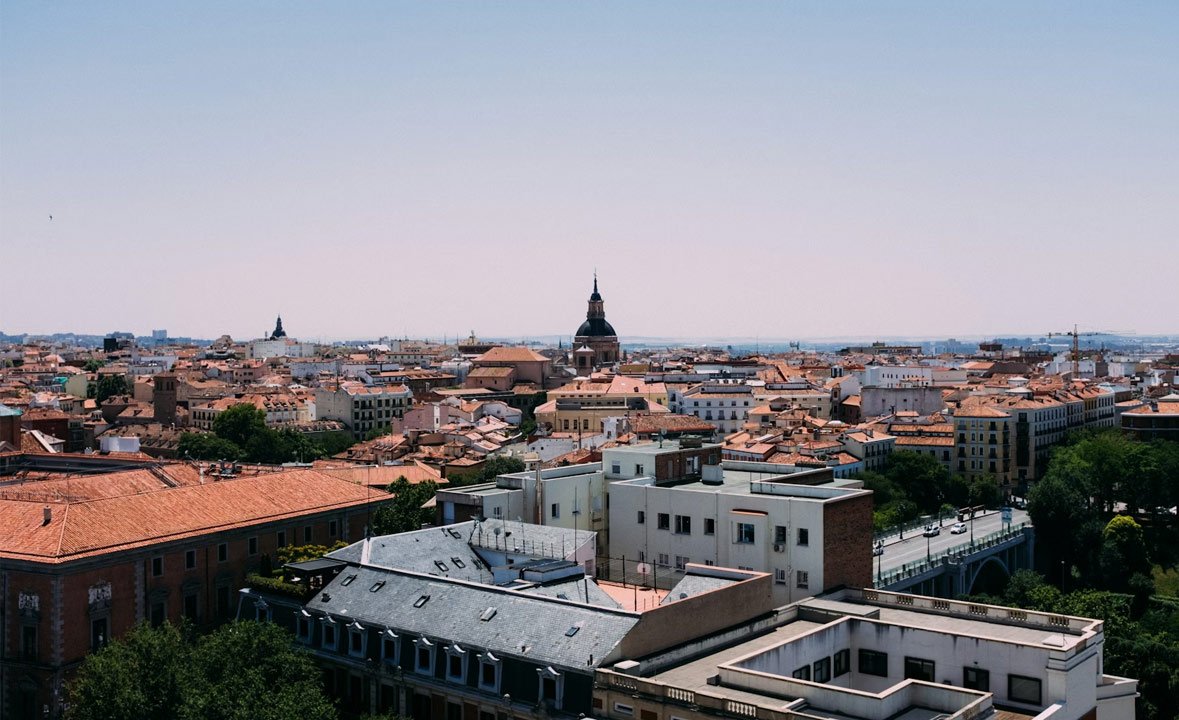
Madrid presents an entirely different architectural personality. Here, grandeur prevails: broad boulevards, Neoclassical façades, and elegant squares give the city a sense of regal confidence.
Key highlights include:
- The Royal Palace: one of Europe’s largest palaces, adorned with baroque detail
- Almudena Cathedral: strikingly young for a cathedral, completed in 1993
- Plaza Mayor: a perfectly proportioned 17th-century square steeped in atmosphere
- Gran Vía: a showcase of early 20th-century architecture, including the iconic Telefónica Building
For modern design lovers, the Cuatro Torres business district and CaixaForum (with its vertical garden) offer sleek lines and bold contrasts. Madrid excels in blending tradition with innovation — a capital always looking forward while respecting its past.
Seville: Moorish Patterns and Golden Light
Seville distils the essence of Andalucían architecture. Its buildings glow in warm tones of ochre, terracotta and gold, their details inspired by centuries of Islamic, Christian and Mudéjar craftsmanship.
The Real Alcázar is the star. This palace complex, still used by the Spanish royal family, is an exquisite blend of carved stucco, coloured tilework, intricate wooden ceilings and peaceful courtyards filled with orange blossom. Each room tells a different chapter of Seville’s cultural story.
Nearby, the Seville Cathedral — one of the world’s largest Gothic cathedrals — rises with breathtaking power. Climb the Giralda Tower, once a minaret, for panoramic views over the city’s rooftops.
Seville’s architecture isn’t frozen in time. The modern Metropol Parasol, known as “Las Setas,” adds an unexpected but brilliant wooden landmark to the city’s historic heart.
Granada: The Alhambra’s Timeless Beauty
No architectural journey through Spain is complete without the Alhambra — a palace-fortress that stands as one of the most breathtaking examples of Islamic art and architecture in the world.
Here, geometry becomes poetry: carved stucco blooms across walls like lace, courtyards flow with marble paths and fountains, and water channels reflect arches and columns in perfect symmetry. The Court of the Lions, with its slender pillars and iconic fountain, is a masterpiece of proportion and detail.
The Alhambra’s sister site, the Generalife, brings serenity through gardens, cypress-lined walkways and terraces overlooking Granada. Together, they create a deep, immersive experience in beauty, silence and geometry.
Santiago de Compostela: Romanesque Grandeur in the North
In the greener landscapes of Galicia, the Cathedral of Santiago de Compostela stands as a grand finale to the historic Camino de Santiago pilgrimage route. Its Romanesque structure, later embellished with Baroque flourishes, commands the central square.
The cathedral’s façades, altars and cloisters reflect centuries of devotion, while the rooftop views emphasise the city’s medieval charm.
Bilbao: Contemporary Vision and Cultural Revival
Bilbao represents the best of Spain’s contemporary architecture. The Guggenheim Museum, designed by Frank Gehry, ignited a cultural renaissance with its titanium curves and riverfront presence. Nearby, Zaha Hadid’s footbridge, Santiago Calatrava’s buildings and Norman Foster’s metro entrances continue to shape a modern, confident city.
It’s a powerful contrast to Spain’s historic sites — proof that the country’s architectural story is still evolving.
Final Thoughts: A Country Built on Imagination
Spain is a place where architecture doesn’t just sit quietly — it speaks, inspires, and often astonishes. From Gaudí’s whimsical creations to the precision of Gothic cathedrals and the spiritual tranquillity of Moorish palaces, the country’s buildings reveal a cultural depth unmatched in Europe.
Whether travelling by historic streets or riding sleek trains between cities, Spain offers an architectural journey rich with beauty, meaning and endless creativity.